Edited by iEpikaira*
"Who controls the Rimland rules Eurasia; who rules Eurasia controls the destinies of the world."N. J. Spykman
 |
| Spykman's direct theoretical rebuttal to Mackinder's World Island from The Geography of the Peace. |
To understand the contemporary strategic architecture of the Eastern Mediterranean and the Middle East, one must discard the illusion of isolated crises, ad-hoc diplomacy, or reactive policymaking. What is observed is not a chaotic region, but a highly disciplined, multi-layered spatial geometry designed by the premier offshore balancing power (the United States and its Anglo-Saxon strategic establishment).
The maps related to Yinon (1982), Peters (2006), the FMES (2022), and the US State Department (the "Biden Map") are not mere cartographic exercises. They are the operational blueprints for the management of the central pivot of the Rimland. What follows is the synthesis of this Grand Architecture, tracing the unbroken strategic logic from the deserts of the Levant to the ports of the Baltic, unified by the imperative of energy transit, territorial fragmentation, and civilizational division.
I. The Terrestrial Shatterbelt: Blood Borders and the Levantine Node
The architecture begins in the terrestrial fragmentation of the Middle East. The foundational logic of the Rimland manager is that no sovereign, unified regional hegemon can be permitted to control the energy-rich core of the Eurasian littoral.

|
| The Ralph Peters "Blood Borders" map (2006). Published in the Armed Forces Journal (an independent trade publication). Its publication caused diplomatic friction with Turkey and Pakistan, leading the US military to explicitly disavow it. Turkish media in June 2025 was still making comments on maps general depictions. Source: http://armedforcesjournal.com/peters-blood-borders-map/ |
The Yinon assay (published in "Kivunim" an Israeli Hebrew-language journal in 1982) and Ralph Peters's "Blood Borders" article (published in the Armed Forces Journal-an independent trade publication-in 2006) established the doctrine: the dissolution (Balkanization) of sovereign Arab and Persian states into ethnic and confessional micro-entities. The October 7, 2023 attack of Hamas on Israel and the subsequent December 2024 fall of the Assad regime by former jihadist Ahmed al-Sharaa (HTS), is part of the execution of this doctrine.
A unified Syria under Assad possessed the sovereign veto power to nationalize or block energy corridors. A fragmented, confessionalized Syria—divided into Alawite, Druze, Sunni, and Kurdish cantons—lacks this capacity. However, this dynamic introduces a profound structural paradox for the managing power: while fragmentation removes sovereign vetoes, capital-intensive energy infrastructure inherently requires regional stability. Consequently, managing this chaotic "shatterbelt" becomes an immense logistical challenge rather than simply providing a perfectly pliable transit zone.
II. The Arterial Corridor: The Four Seas Project
With the Levant fragmented, the economic rationale for the architecture is actualized via the Four Seas Project (revived by Thomas Barrack, US Ambassador in Turkey in 2026). This corridor is designed to link the Arabian Gulf, the Caspian Sea, the Mediterranean, and the Black Sea, effectively bypassing the Heartland powers (Russia and Iran) while integrating their periphery into the maritime economy.

|
| The initial Four Seas Project that is currently being reviewed by Tom Barrack |
However, a corridor is only as secure as its most vulnerable chokepoint. The Four Seas Project requires a western terminus in the Mediterranean and a northern terminus in the Black Sea. To secure these termini, the managing power must negotiate with—or neutralize—the two historical gatekeepers of the Anatolian land bridge and the Aegean archipelago: Turkey and Greece.
III. The Bisection of the Land Bridge: The FMES Purple Line
Here we encounter the Strategic World Atlas (The "Fondation Méditerranéenne d'Etudes Stratégiques" is a French naval and strategic think tank -FMES- that published this map and was forced to withdraw it few days later) and its defining feature: the Purple Line. This line represents the perimeter of American commandement—the space where the US will project hard power to defend the Rimland.

|
| Strategic World Atlas (FMES). |
Crucially, the Purple Line does not defend a unified Turkey. The cartography conceptually bisects it.
- The Western Rump: Retained within the Western security perimeter, granted maritime access, and utilized as a regional manager.
- The Eastern Periphery: Conceded to the logic of Blood Borders (Kurdistan, fragmentation), serving as the terrestrial node for the Four Seas pipeline network.

|
| Strategic Atlas of the Mediterranean and the Middle East (FMES) |
IV. The Maritime-Legal Matrix: The Biden Map and the Aegean Neutral Zone
If the FMES Purple Line maps the land, the "Biden Map" (the 2014 State Department/Acheson Plan evolution) visualizes the management of the sea. Its operational purpose is to prevent the emergence of a regional maritime hegemon in the Eastern Mediterranean by systematically pushing to internationalize the water column.

|
| The "Biden map". Source: mcclatchydc.com |
By limiting the sovereign maritime footprint of Kastellorizo, encouraging overlaps in the EEZ east of the 28th meridian, and complicating the Greek-Cypriot maritime boundary, the architecture establishes a contested zone. In the grammar of offshore balancing, a contested space is heavily reliant on a managed space.
This brings us to the operational core of the entire system: the Aegean "Neutral Zone". Pressures to demilitarize specific islands and maintain restricted nautical mile claims are frequently driven by hard operational requirements rather than mere Greco-Turkish confidence-building:
- Military Transit: It guarantees US/NATO submarines and aircraft unrestricted transit between the Mediterranean and the Black Sea.
- Infrastructure Security: It serves as a physical mechanism for open transit to the Black Sea terminus of the Four Seas corridor.
The Aegean neutral zone is envisioned as the suture point that binds the Middle Eastern pipelines to the European market. Yet, this introduces a critical strategic vulnerability: if the managing power strips Greece of its sovereign capability to defend this very archipelago, it leaves the vital chokepoint of this grand architecture exposed to external interference. True grand strategy dictates that a vital infrastructure hub must be fiercely defended by a capable ally, not structurally dissolved.
V. The Northern Nexus: The Three Seas Initiative and the Alexandroupolis Hinge
The strategic logic extends northward. Because the Ukraine war has rendered the Black Sea a heavily contested military zone, the traditional Black Sea termini of the Three Seas Initiative (3SI) (Baltic-Adriatic-Black Sea) carry elevated risks.

|
| Three Seas Inititative (3SI): The original 12 member states Austria, Bulgaria, Croatia, Czech Republic, Estonia, Hungary, Latvia, Lithuania, Poland, Romania, Slovakia, and Slovenia. In 2022, Ukraine received the status of a partner-participant. In 2023 Greece became a member, and Moldova a partner-participant. In 2025, Albania and Montenegro became partner-participants. The purple line is drawn based on FMES map. |
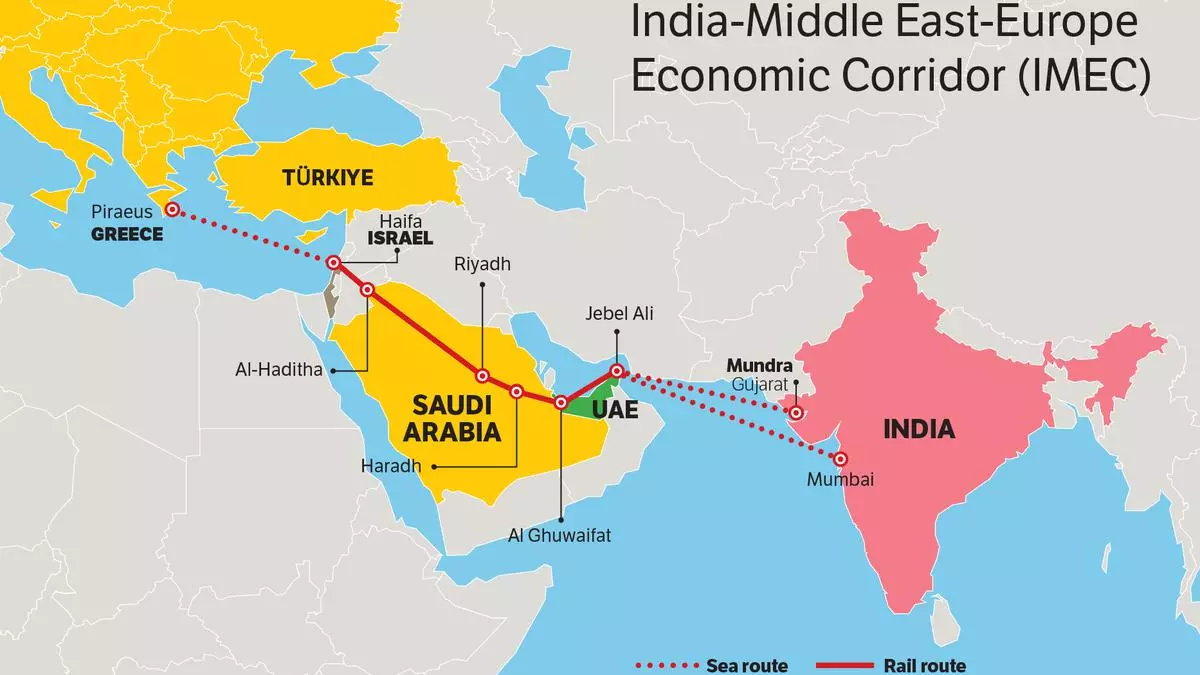
Consequently, the architecture pivots to the safest of the four seas: the Aegean. Greece is integrated into the 3SI and the IMEC (India-Middle East-Europe Corridor) to serve as the ultimate energy and logistical lung for Central and Eastern Europe.
|
| India-Middle East-Europe Corridor (IMEC) |
The port of Alexandroupolis emerges as the supreme geopolitical hinge of the 21st-century Rimland. It is simultaneously:
- The Aegean terminus of the 3SI
- The logistical gateway for IMEC
- The LNG entry point for Caspian and Gulf gas bypassing Russia

|
| The speculative greek SEZ Map |
The push to create a Special Economic Zone (SEZ) in Alexandroupolis reflects the final stage of spatial management: the cantonization of sovereign territory. Just as Syria is fragmented to allow pipelines to flow, Greek territory is functionally delineated to ensure the corridor operates smoothly. Greece is elevated as the indispensable gateway, but the structural demands of the alliance require portions of its autonomy to be subordinated to the broader transit network.
VI. The Heartland's Counter-Stroke: Mackinder Strikes Back
Strategy, however, is inherently dialectic. The Western grand architecture does not exist in a vacuum; it is a direct response to the counter-maneuvers of the Heartland. While the offshore hegemon constructs IMEC and the Three Seas Initiative along the inner Rimland, the Sino-Russian axis is actively forging the International North-South Transport Corridor (INSTC). This massive infrastructural artery connects Russia directly to Iran and the Indian Ocean via the Caspian Sea, deliberately bypassing Western maritime chokepoints, the Turkish straits, and the Greek logistical hinge entirely.
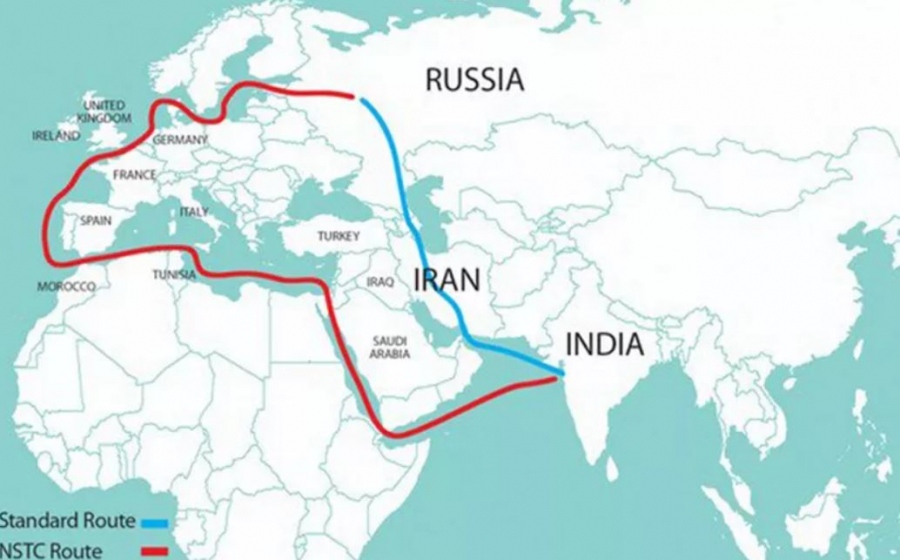 |
| International North–South Transport Corridor (INSTC) |
Viewed through this dialectical lens, the Five-Layer Architecture mapped previously is not merely an offensive play for global hegemony; it is a frantic defensive wall. The deliberate fragmentation of the Levant, the push for an Aegean neutral zone, and the intense militarization of Alexandroupolis are desperate, structural attempts to quarantine the Heartland. The ultimate objective of the Rimland manager is to prevent Russia and China from breaking through the continental interior to access the warm waters of the Mediterranean and the Persian Gulf, thereby denying them the strategic depth required to challenge maritime primacy. Mackinder’s ghost is actively contesting Spykman’s blueprint.
VII. The Cultural Superstructure: Huntington as the Ideological Operating System
A grand strategy of this magnitude requires an ideological framework to contextualize the realignment of alliances and the shaping of sovereign states. In this analysis, that is provided by Samuel Huntington's "Clash of Civilizations."

|
| Huntington’s "rigid" clash of civilizations map |
Huntington's thesis is argued by some to be applied as a weaponized geopolitical tool. The strategic establishment utilizes the Orthodox-Islamic fault line to solidify the permanent severing of any historical Greek-Russian Orthodox alignment.
- By framing regional disputes through a civilizational lens, the managing power rationalizes the insertion of strategic wedges between historically intertwined geographies.
- This works to block Russian access to the warm waters of the Mediterranean, turning the Black Sea into a highly managed strategic basin.
Furthermore, the instrumentalization of cultural discourse serves to steer the internal societal cohesion of regional actors. However, relying purely on Huntington’s clash model reveals a stark contradiction in Western strategy: integrating Greece deeply into core Western economic and security frameworks (like 3SI and IMEC) intrinsically proves that Greece is valued as an essential pillar of the West, fundamentally conflicting with the narrative of it being a suspect "civilizational outlier."
VIII. The Spykman Synthesis: Hegemony Without Presence - The Five Layer System
The Complete Architecture
The complete architecture comprises five interlocking layers, each interacting with the others to form the macro-strategy:
- Layer 1 — Cultural/Ideological: Huntington's fault lines used to sever regional ties:
- Civilizational framing used to sever historical regional ties.
- Instrumentalization of cultural policies to manage societal cohesion.
- Confessional fragmentation as the deepest layer of the geopolitical restructuring.
- Layer 2 — Territorial: Yinon/Blood Borders conceptualizing Levantine fragmentation:
- Fragmentation of the Levant into micro-entities.
- Strategic empowerment of non-state actors (Kurds) as pipeline nodes.
- Attempted structural bisection of Anatolia (FMES), heavily contested by Ankara.
- Post-Assad Syria envisioned as a managed transit zone.
- Layer 3 — Maritime-Legal: The Biden Map diluting maximalist claims and creating neutral transit zones:
- Dilution of maximalist maritime claims in the Eastern Med.
- "Neutral transit zones" prioritizing unimpeded NATO maneuverability.
- Designation of free transit straits unilaterally.
- Crete-Cyprus arc as Western security axis.
- Layer 4 — Infrastructure: The Four Seas, Three Seas, and IMEC corridors:
- Four Seas: Gulf → Caspian → Syria → Mediterranean → Black Sea.
- Three Seas: Baltic → Adriatic → Black Sea → Aegean.
- IMEC: India → Gulf → Levant → Greece → Central Europe.
- Alexandroupolis as convergence node of major corridors.
- LNG terminals, pipelines, Via Carpatia, rail corridors.
- Special Economic Zones at core corridor termini.
- Layer 5 — Military-Strategic: The FMES containment perimeter:
- FMES boundary marking limits of security guarantees.
- Turkish projection managed through multi-directional balancing.
- Aegean optimized for submarine/air freedom of maneuver.
- Cyprus as forward operating base (British SBAs + US footprint).
- Israel as eastern flank guarantor (Nagel doctrine).
- Russia structurally contained within the Mediterranean theater.
The Spykmanesque Logic of the Integrated System
Read through Spykman's lens, the five-layer architecture represents a highly sophisticated application of Rimland theory in modern grand strategy. Spykman argued that the Rimland must never be permitted to unite under the control of a single power. The integrated architecture goes further: it ensures that the Rimland remains structurally divided—especially now that the hegemonic power is too distracted to be able to continue regional policing. Every layer serves the macro-function of preventing any single sovereign actor from monopolizing the critical energy-transit system that runs along the inner Rimland from the Gulf to the Baltic—the epitome of "divide and rule".

- Layer 1 discourages broad civilizational coalescence (Orthodox bloc, Pan-Islamic bloc).
- Layer 2 attempts to prevent territorial coalescence (unified regional hegemons).
- Layer 3 manages maritime coalescence (ensuring overlapping jurisdictions rather than absolute exclusions).
- Layer 4 dilutes economic coalescence (preventing hostile nationalized pipelines or sovereign energy cartels).
- Layer 5 prevents military coalescence that could exclude the offshore balancer.
The fragmentation is the tool. The corridor is the means. The ultimate goal is structural alignment and dependence on the managing offshore power. This is the precise execution of Spykman's prescription: a maritime power actively managing the internal balance of the Rimland to ensure that no rival — Heartland or Rimland — can ever challenge its primacy or unite the Eurasian coastline.
The Convergence Table
| Document | Geographic Focus | Strategic Plane | Function in the Chain |
|---|---|---|---|
| Yinon Plan (1982) | Levant / Mesopotamia | Political-doctrinal | Identifies fragmentation targets; designates Kurds as natural nodes |
| Peters Blood Borders (2006) | Middle East | Territorial-cartographic | Maps the fragmentation; visualizes the political vacuum |
| FMES Strategic Atlas (2022) | Eastern Med / Middle East | Military-strategic | Defines Western security perimeters; envisions conditional abandonments |
| Biden/Acheson Map (c. 2014) | Aegean / Eastern Med | Maritime-legal | Dissolves absolute sovereign maritime jurisdictions; prioritizes shared transit |
| Barrack Four Seas (2026) | Gulf → Syria → Med → Black Sea | Economic-infrastructure | Provides the revenue logic; converting geopolitics into investment |
| Three Seas Initiative (2015–23) | Baltic → Adriatic → Black Sea → Aegean | Institutional-infrastructure | Extends the corridor northward; integrating Greece as vital southern terminus |
| Huntington Clash (1996) | Global / Civilizational | Cultural-ideological | Provides the legitimizing narrative framework for macro-alignments |
No single document is sufficient. The FMES map without the Biden map explains the terrestrial focus but not the maritime architecture. The Biden map without the Blood Borders logic explains the maritime zones but not the terrestrial fragmentation required for pipelines. The Four Seas corridor without the Three Seas Initiative explains the southern arc but lacks a reliable northern extension. Together, they constitute a comprehensive operational framework for the post-2026 Rimland order, driven by the dominant offshore power.
IX. CONCLUSION: The New Rimland Order and the Greek Paradox
The Atlas Is Being Written in Real Time
The maps drawn and doctrines formulated over the last decades are no longer theoretical provocations. They represent the operating system of the current Rimland order. Major regional shifts, such as regime collapses in the Levant or immense infrastructural investments like the Three Seas Initiative’s expansion into the Aegean, convert these blueprints into a physical continental architecture.
The chain binds the architecture together:
Middle East Fragmentation → Four Seas Infrastructure → Maritime Transit Imperatives (Biden Map) → Eastern Mediterranean Pivot → Aegean Logistical Suture → Three Seas Initiative to the Baltic.
Every link in this chain influences the other. Remove the fragmented transit zones, and the corridors fail. Remove the Aegean logistical suture, and the Three Seas Initiative lacks its vital southern anchor. The systemic design is circular: each element justifies and necessitates the others to maintain the overarching strategy.
The Greek Paradox: Gateway and Vulnerability
The position of Greece within this architecture is one of profound structural duality — the Spykmanesque paradox of the Rimland state that is simultaneously designated as indispensable yet subjected to severe external management.
The Three Seas Initiative and IMEC elevate Greece as the southern anchor and "strategic gateway" into Europe. The LNG infrastructure at Alexandroupolis makes Greece an indispensable energy security guarantor for the Balkans. Greece is the critical Rimland node where the inner and outer maritime spheres converge.
Simultaneously, maritime frameworks like the Biden map push to dilute absolute Greek maritime sovereignty in favor of internationalized transit. While cultural frameworks occasionally attempt to cast the region as a civilizational outlier, the reality of Greece's indispensable role as a Western anchor actively defies that framing. You do not build your most vital continental security architecture upon a state you fundamentally distrust.
Greece navigates two conflicting pressures: the requirement to be a fortress gateway and the pressure to yield sovereign concessions for alliance transit. The gateway function requires strong Greek territory, ports, and military capabilities. The alliance transit function demands maritime flexibility, military restraint, and territorial cantonization via SEZs. The more indispensable the gateway becomes, the more intensely the managing power seeks to oversee its mechanisms.
The geographic vulnerability inherent in Spykman's framework is that the Rimland state that occupies the critical chokepoints is always subjected to the heaviest gravitational pull of great power restructuring, specifically because of its immense value to the global system.
The Final Spykmanesque Assessment
Spykman warned that the Rimland was the key to global power. He argued that the Rimland must never unite under a single power to protect American offshore hegemony. This multi-layered fragmentation is, in reality, the precise operationalization of his theory. Spykman did not necessarily seek to defend the absolute, pristine sovereignty of individual Rimland states; his objective was to defend the global balance of power.
The new Rimland order is defined by structural alignments—between heavily leveraged Western anchors like Greece and robust, fiercely independent actors like Turkey; between fragmented Levantine corridors and managed maritime zones. The managing power relies on deep structural integration, ensuring that the geographic destiny of these regions remains tethered to its own strategic imperatives.
The atlas of the 21st century continues to be drawn. The strategic perimeters outline the influence, the pipelines constitute the veins, and the transit zones form the arteries of this grand architecture.
"The question for every actor in this theater is no longer whether the architecture is being built. It is whether they will be subjects of the architecture or objects of it. And for the smaller actors—like Greece and Cyprus—the answer is already visible in the maps. They are objects. They are transit zones. They are gateway and sacrifice. Greece, in particular, holds the paradoxical role of the Iphigenia of the Rimland: simultaneously the indispensable gateway for Western energy security and the expendable sacrifice required to loose sovereignty in the Aegean and the Eastern Mediterranean, whilst keeping the Orthodox world divided. The atlas is being written, and Hellenism is not holding the pen."
Spykman's ghost would undoubtedly recognize the geography. By utilizing structural divisions within the Rimland to prevent a unified continental rival, the maritime power aims to achieve what Spykman prescribed as "global offshore hegemony".
Viewed through the historical lens of imperial life cycles, this structural fragmentation is a classic symptom of hegemonic contraction. Just as the British Empire, during its precipitous decline, weaponized the "divide and rule" principle—leaving behind the bloody cantonization of India and Pakistan, and the unresolved ethnic fracturing of Cyprus—the contemporary offshore power is adopting an identical playbook. As direct geopolitical policing becomes militarily and economically unsustainable, a retreating hegemon relies on deliberately engineered shatterbelts to deny space to rising regional successors. For a critical Rimland node like Greece, this historical parallel is exceptionally dangerous. It implies that the grand architecture being imposed is not ultimately designed to secure and stabilize the region, but rather to permanently fracture it to cover a strategic retreat, leaving local anchors to absorb the ensuing chaos. Some may argue that this appears to be —to a certain extent— an intentional plan—it wouldn't be called "Blood borders" otherwise—, although emerging geopolitical dynamics suggest momentum is shifting in an unprecedented direction.
The Final Trap
There are currently signs suggesting that the grand strategic blueprint is about to devolve into a geostrategic trap—The Spykman Trap. The US role of offshore balancer—attempting to manage the Eurasian Rimland through controlled demolition and fortified geoeconomic corridors—is colliding with reality. The "Blood Borders" doctrine (in Syria-Palestine-Lebanon), coupled with the asymmetric Iranian reaction (affecting Saudi Arabia, UAE, Bahrain, Kuwait, Qatar), is producing regional friction that tends to disperse rather than create manageable Balkanization. By attempting to build an armored economic citadel while intentionally letting the terrestrial periphery burn, the architects of this strategy are yet far from securing the Rimland; instead, they appear trapped in a volatile shatterbelt and are effectively close to losing the world, as detailed in our previous analyses.
Further reading:
- THE HEGEMON’s ESCAPE: Why America is blowing up its own world order
- Three Endgames: Scenarios for the Iran War and the Post-American Order
- DRAWN IN BLOOD: The Deliberate Demolition of Sykes-Picot and the Architects of the New Middle East
.png)