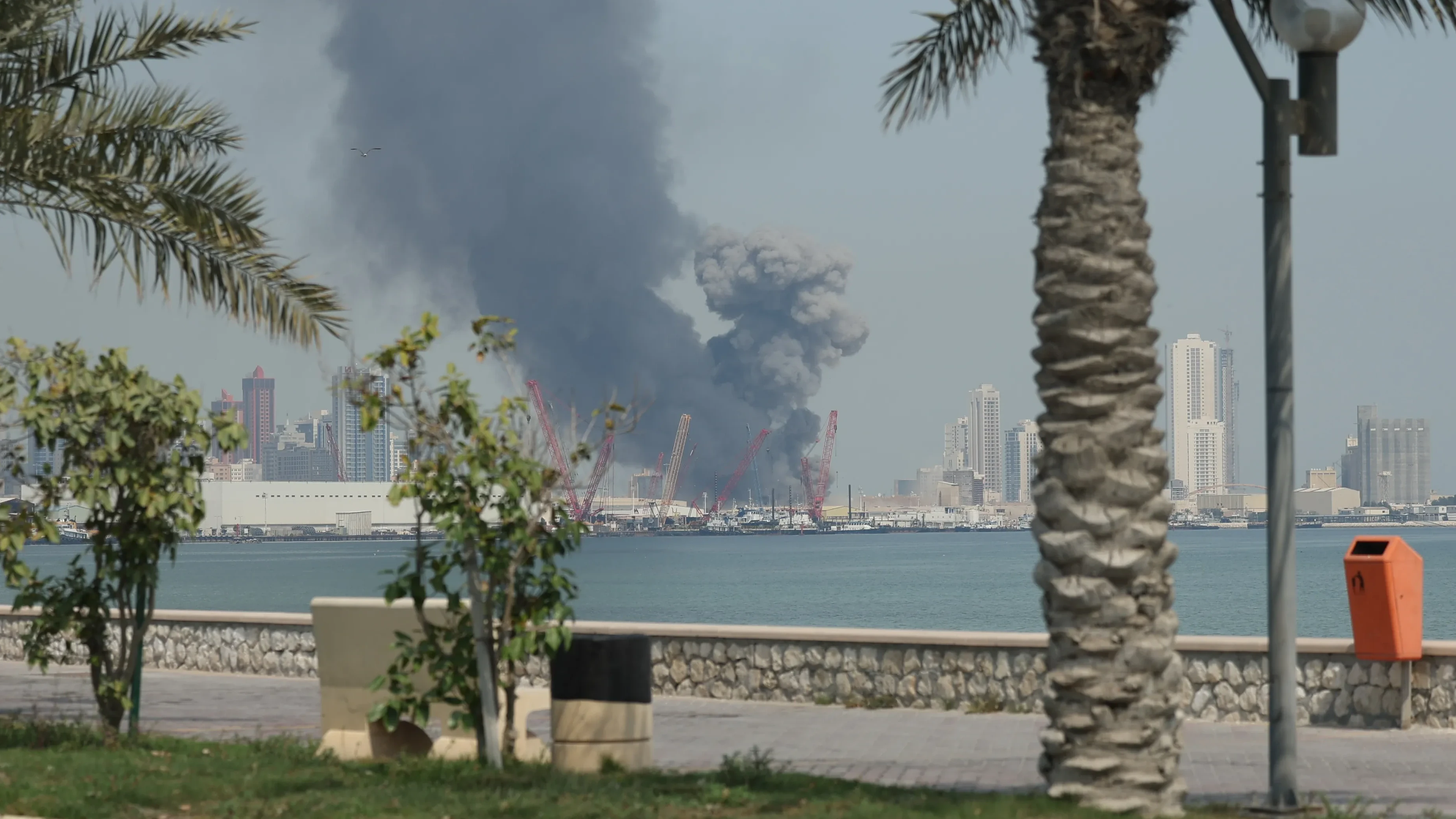
Hosting the US Fifth Fleet and other key military assets makes Bahrain a frequent target of Iranian retaliation
The presence of the US Fifth Fleet and key US radar installations is pushing Bahrain's economy to the brink of crisis, as the oil-rich kingdom faces repeated Iranian retaliatory strikes, the Wall Street Journal (WSJ) reported on 24 November.
Exchanges of fire between Iran and the US and its allies have continued in recent weeks, with Bahrain bearing the brunt of the most recent Iranian retaliatory strikes,
Iranian retaliatory attacks have badly damaged a command headquarters, at least 12 other buildings, and two satellite communications terminals, WSJ noted.
With shipping through Hormuz disrupted, Bahrain's oil output has fallen by more than half to 46,000 barrels per day (bpd), while its exports to China have all but vanished in September.
State-owned energy company Bapco's refinery is running at 80 percent capacity, while Aluminium Bahrain's output fell 41 percent in the first nine months of 2026.
The International Monetary Fund (IMF) expects Bahrain's economy to contract 11.3 percent this year, among the steepest declines in the Gulf, as public debt climbs to 163 percent of GDP.
Only three countries in the world carry a heavier public debt load.
With foreign currency reserves more than halved since March to $2.4 billion and two-thirds of a $5.3 billion UAE currency swap reportedly drained, Manama is seeking another bailout from its Gulf neighbors.
Prospective lenders, however, are pressing for spending cuts and the sale of state assets, measures the government fears could spark public unrest.
“Without Gulf financing, Bahrain would probably be staring at a messy devaluation and sovereign default,” Jason Tuvey of Capital Economics warned.
This comes after Iran's Islamic Revolutionary Guard Corps (IRGC) struck US Patriot air defense systems at Washington's bases in Bahrain's Riffa and Awali on 22 November, in retaliation for US drone incursions into Iranian airspace.
Bahrain's economic crisis forms part of a wider toll on the Persian Gulf, where the US-Israeli war on Iran has caused more than $200 billion in physical damage and is set to wipe out $790 billion in expected growth by 2030, according to an Allianz Trade report published earlier this month.
Iranian retaliatory strikes on US assets hit more than 80 energy facilities across host states, mostly in Kuwait, Qatar, and Bahrain, leaving about a third heavily damaged.
Gulf governments are expected to offset some of the war losses by diverting about $120 billion from their sovereign wealth funds into domestic investment through 2030, leaving less capital to deploy abroad, while surpluses from trade and overseas holdings are forecast to fall by half.
IMF regional director Jihad Azour warned in mid-October that the Gulf's oil-producing economies will not regain their pre-war growth path in the medium term, as the reserves, stockpiles, and alternative routes that spared the region an energy crisis are nearly exhausted.
[iEpikaira: Επιβεβαίωση των όσων γράψαμε ΕΔΩ!]
Source: https://thecradle.co/articles/us-military-presence-pushes-bahrains-economy-toward-financial-crisis-report