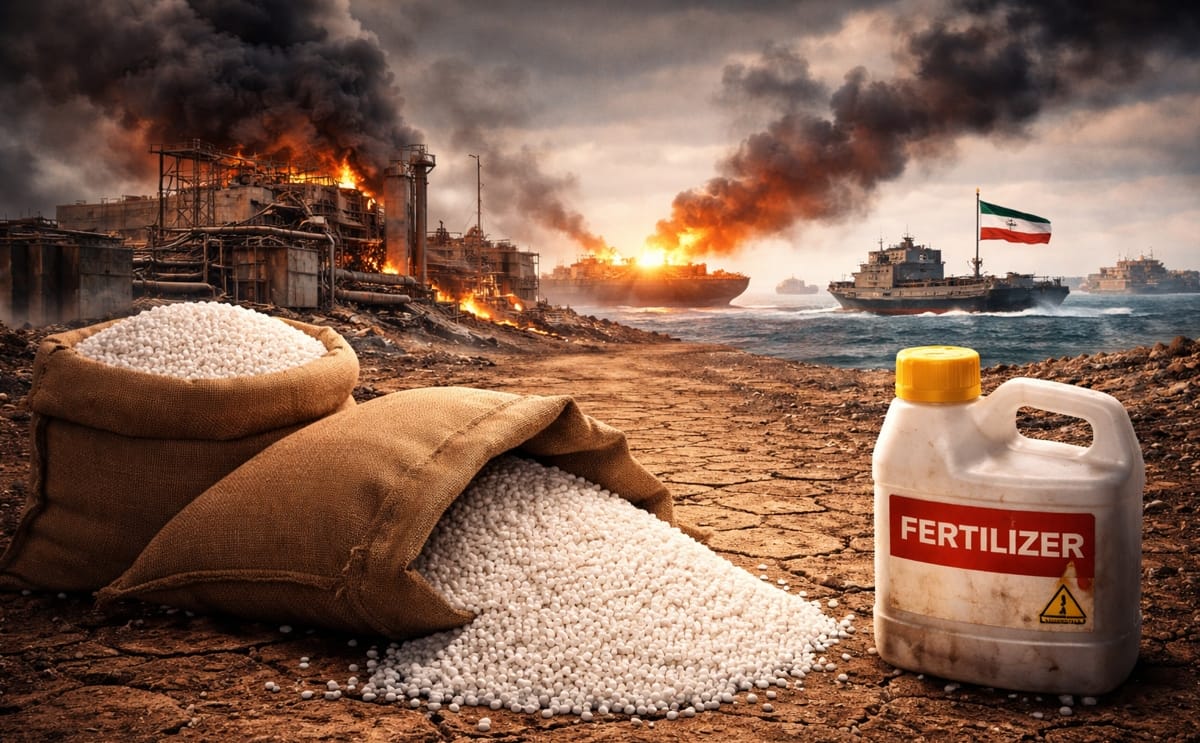
The war in Iran is no longer a regional conflagration contained by geography or diplomacy. It is becoming a systemic stress test for the global order—one where the most immediate battlegrounds are not measured in territory seized, but in fertilizer shipments delayed, shipping insurance premiums doubled, and grocery bills inflated from São Paulo to Singapore.
The heart of the crisis
At the heart of the crisis lies the Strait of Hormuz. The conflict has weaponized global logistics. Shipping war-risk insurance, once a niche concern, has become a line item that reshapes corporate strategy. The result is a supply chain under perpetual disruption—a new baseline, as industry analysts note, rather than a temporary shock.
The economic fallout is cascading. Oil prices, on a rollercoaster breached the $100 mark several times, transmitting inflationary pressure through energy-intensive sectors. But the more insidious threat may be to food security. Iran and its regional neighbors are critical nodes in the global fertilizer trade; disruptions there have sent prices surging to near-crisis levels. For farmers in Brazil, Argentina, and the American Midwest, this means higher input costs ahead of planting seasons already strained by climate volatility. For import-dependent nations across Africa and Southeast Asia, it raises the specter of harvest shortfalls and social unrest.
Alarms sounding
Global economic institutions are sounding alarms. The IMF has warned that prolonged conflict could tip fragile economies into recession, while the FAO cautions that time is running out to avert a food security crisis. Yet the political calculus remains stubborn. U.S. sanctions continue to target Iran's financial "arteries," even as analysts question whether economic pressure alone can alter the regime's behavior. Meanwhile, Russia and China stand to gain strategic leverage.
The path ahead is fraught with uncertainty. A diplomatic off-ramp remains possible, and markets have shown some resilience thus far. But the structural vulnerabilities exposed by this conflict are unlikely to vanish with a ceasefire.
Greece in the Crossfire
Greece, still navigating the aftershocks of its debt crisis, finds itself uniquely exposed to the escalating conflict in Iran—not through direct military entanglement, but through the delicate arteries of global commerce on which its economy depends. The nation's vulnerabilities are concentrated in five interlocking sectors: energy, shipping, tourism, trade, and financial markets.
Energy Dependence: The Primary Fault Line
Greece's most acute exposure lies in its energy mix. Approximately 25 percent of the country's fuel imports originate from Gulf nations, and the closure of the Strait of Hormuz—through which one-fifth of global oil and one-third of seaborne fertilizer flow—has sent immediate shockwaves through domestic markets. Scope Ratings warns that Greece's high dependence on fossil fuels leaves it particularly susceptible to supply shocks; while a return to 2022-level gas prices is deemed unlikely, sustained elevated prices could reignite inflationary pressures just as the economy stabilizes.
The ripple effects are tangible: fuel price surges linked to the Iran conflict have already cost Greek consumers more than €400 million in two months alone. With national economic planning for 2026 predicated on lower energy assumptions, the government has been forced to deploy emergency fuel subsidies and legislative measures to shield households.
Food Security: Indirect but Significant Risks
Greece does not rely heavily on Gulf-sourced fertilizer imports, but it is not insulated from global price dynamics. Disruptions to Hormuz have tightened international fertilizer markets, contributing to upward pressure on agricultural input costs worldwide. For a country where agriculture remains a meaningful employer and export sector, sustained high fertilizer prices could squeeze farm margins and, over time, affect domestic food production costs.
More immediately, food inflation in Greece—already elevated by prior crises—is being reinforced by higher transportation and energy costs. Between 2019 and 2024, moderate to severe food insecurity affected 6 to 8 percent of the Greek population; renewed price pressures risk reversing hard-won gains in household resilience.
Tourism: The Soft-Power Vulnerability
Tourism, contributing roughly 25 percent of GDP, faces a subtler but potent threat. Visitors from the United States and Asia often conflate the Eastern Mediterranean with broader Middle Eastern instability, potentially triggering cancellations of cruises and multi-destination itineraries. Industry estimates suggest a prolonged conflict could cost Greece €2.1 to €2.6 billion in tourism revenue, excluding secondary effects on employment and regional economies.
Fiscal Space and the Eurozone Shield
Greece's capacity to absorb these shocks is constrained but not absent. Public debt remains above 160 percent of GDP, limiting fiscal maneuverability. Fitch Ratings notes that while Greece faces genuine energy-shock risks, its integration into eurozone frameworks offers a measure of protection. Still, the rating agency cautions that a prolonged, widening conflict could test even these safeguards, particularly if stagflationary pressures take hold.
The Path Forward
Greece's exposure to the Iran conflict underscores a broader truth of the modern global economy: geographic proximity is less decisive than systemic interdependence. The country is not a battlefield, but it is a transmission node—vulnerable to disruptions in energy flows, shipping lanes, and consumer confidence that originate thousands of miles away.
Until the Strait of Hormuz reopens with predictable regularity—or until Greece and its European partners meaningfully diversify energy and trade corridors—the nation's economic and food security will remain tethered to the volatility of a distant war.
Interactive Famine Model Simulator (click on three scenarios and choose between countries)
Interactive Famine Model Simulator (click on three scenarios and choose between countries)
Hard lessons
The war in Iran is less about who controls the next hill than about who controls the flows—of energy, food, capital, and trust—that sustain modern life. Until those flows are secured, the global economy will remain in a state of managed vulnerability, navigating a narrow strait of its own making.
The world is learning, at considerable cost, that in an interconnected system, a crisis in the Persian Gulf does not stay in the Gulf and, resilience is not measured by the absence of risk, but by the capacity to adapt while the storm rages.
[Visit the Iran War Monitor HERE!]
*utilizing iEp™ widgets and AI
.png)