Abdullah Bozkurt/Stockholm
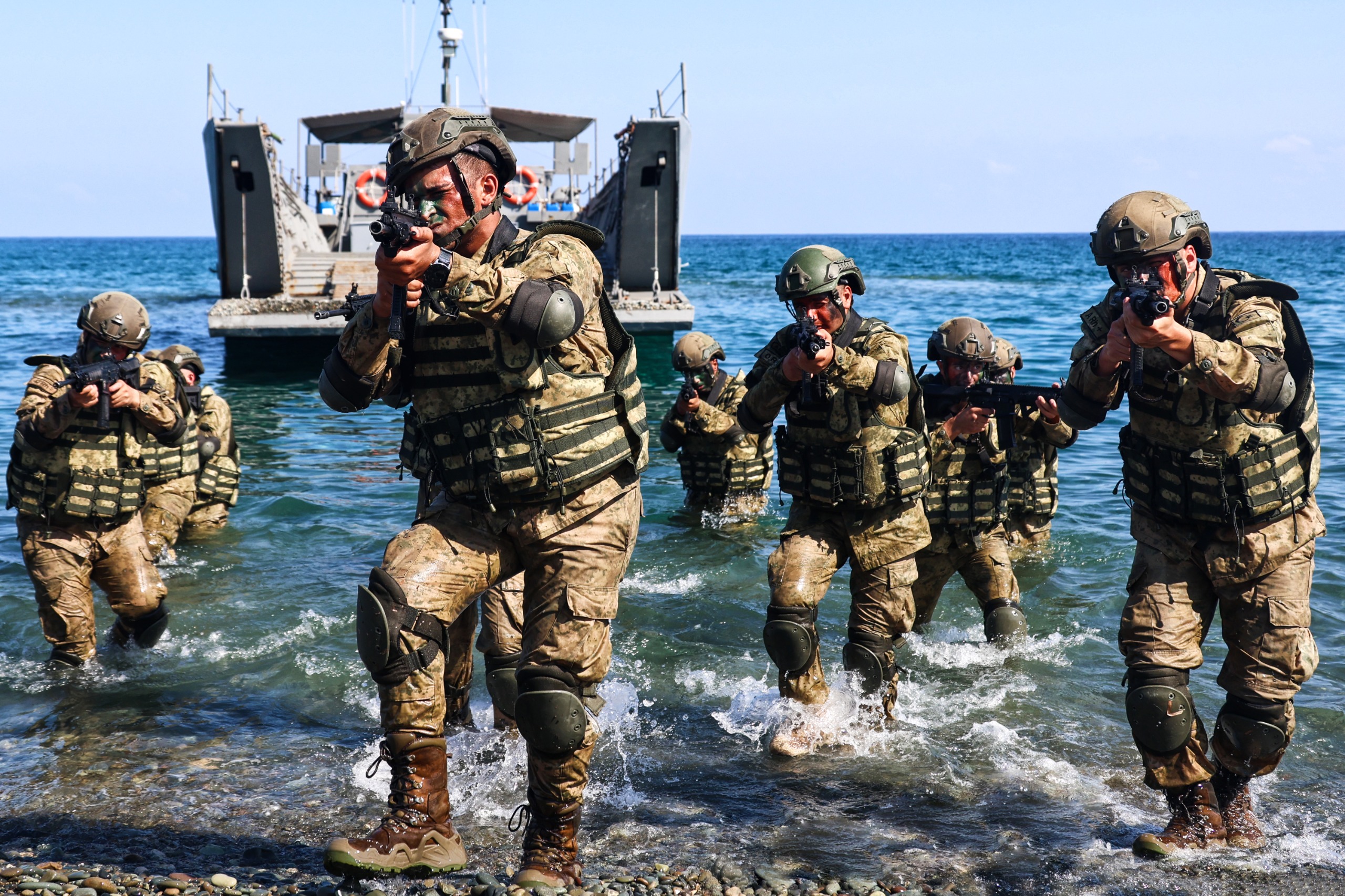
A series of recent measures adopted by the government of Turkish President Recep Tayyip Erdogan indicates that the country is preparing for a war-like scenario, marked by sweeping changes to military and civilian mobilization rules, the expansion of logistical supply systems and an aggressive push to advance missile and drone capabilities.
Although Ankara has not explicitly identified a specific adversary, growing evidence suggests that the Erdogan government may be steering Turkey toward a potential military confrontation with Israel, possibly in the Syrian theatre. This concern is reinforced by increasingly belligerent rhetoric from senior officials and a notable shift in Turkey’s strategic doctrine, in which the Jewish state is now framed as a fundamental national security threat.
Erdogan has previously attempted to push Turkey toward such a confrontation. In 2010, following the deadly Mavi Marmara incident in the eastern Mediterranean, he sought a military response against Israel but was ultimately blocked by resistance from senior generals. That institutional constraint, however, has since been dismantled.
Over the past decade, Erdogan has systematically consolidated power and reshaped the state apparatus. In 2014 he shut down a long-running counterterrorism investigation into a network linked to Iran’s Islamic Revolutionary Guard Corps Quds Force, paving the way for pro-Iranian figures to rise within the intelligence, police, military and diplomatic services.
Following the false flag coup attempt in 2016, Erdogan carried out mass purges that removed tens of thousands of officers, including much of the pro-NATO leadership within the armed forces. He appointed Adnan Tanrıverdi, founder of the paramilitary group SADAT, as his chief military advisor, and consolidated sweeping executive powers after a controversial 2018 referendum conducted under total government control of the media.
Under Erdogan’s leadership Turkey has expanded its military footprint abroad, arming Islamist groups in Syria and Libya and establishing overseas military outposts from Somalia to Qatar. Ankara has also deepened ties with Hamas — designated as a terrorist organization by its NATO allies — providing operatives with shelter, funding, logistics support and even Turkish citizenship.
At the same time Turkish intelligence and police have intensified crackdowns on Israeli networks, including alleged Mossad operatives tracking Hamas activities in Turkey, while largely overlooking the presence of jihadist groups and Iranian intelligence networks operating on Turkish soil.
A presidential decree that overhauls the mobilization of civilian resources for military use both before and during wartime, granting sweeping powers to President Recep Tayyip Erdogan:
With these developments Erdogan appears increasingly confident in his ability to pursue a direct confrontation with Israel — and has begun laying the groundwork accordingly.
The clearest sign of this preparation came on May 22, 2024, when Erdogan issued a sweeping presidential decree introducing a new Mobilization and State of War Regulation (Seferberlik ve Savaş Hâli Yönetmeliği). The regulation dramatically expands the government’s authority to mobilize Turkey’s entire civilian, economic and institutional infrastructure for potential conflict scenarios.
Replacing decades-old frameworks, the regulation establishes a system designed to transition the country rapidly from peacetime to a war footing — even in the absence of a formal declaration of war.
At its core is the concept of continuous preparedness, allowing authorities to activate wartime mechanisms not only during war but also in broadly defined “tension” and “crisis” periods. These categories are deliberately vague, encompassing internal unrest, regional instability or perceived security threats, thereby lowering the threshold for invoking extraordinary state powers.
The regulation introduces a doctrine of “total national defense,” placing virtually all sectors of society under potential state control. Public institutions, private companies, industrial facilities and transportation assets — including vehicles, ships and aircraft — can be requisitioned. Civilians with specialized skills may be assigned roles supporting military operations, while private companies can be compelled to produce military goods, allocate personnel or convert production lines.
The obligations extend directly to individuals. Reservists must report within 48 hours of a mobilization order, while civilian vehicle owners may be required to surrender their vehicles within as little as six hours, often along with their drivers. Local authorities are tasked with enforcing compliance and reporting violations.
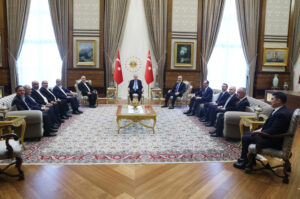
Turkish President Recep Tayyip Erdogan hosted a Hamas delegation led by Mohammad Ismail Darvish in Ankara on January 29, 2025. The president’s intelligence chief, Ibrahim Kalin, Foreign Minister Hakan Fidan and the national security advisor were present at the meeting.
A significant feature of the new framework is the consolidation of authority in the presidency. Erdogan is empowered to declare full or partial mobilization, determine the geographic scope of such measures and decide which sectors and institutions will be affected.
He can also place civilian institutions under military operational control, impose obligations on personnel and resources and regulate evacuation procedures and emergency governance measures. Although mobilization decisions must be submitted to parliament for approval, the regulation allows immediate implementation upon a presidential decree, reinforcing the executive’s already dominant position.
The regulation also introduces mechanisms that allow civilian institutions to be put directly under military command structures. In such cases public agencies and private companies can be subordinated to military authorities, with their logistics, production processes and operational priorities redirected to meet defense needs. This arrangement effectively merges civilian administration with military command during crisis situations, blurring institutional boundaries.
To support this system the government mandates extensive data collection on national resources, including industrial capacity, workforce qualifications, transportation assets and critical infrastructure. This information is stored in centralized electronic systems managed by security institutions, enabling rapid allocation and deployment during emergencies. Authorities are also granted broad powers to inspect both public and private entities to ensure readiness and compliance with mobilization plans.
The regulation further integrates multiple state institutions into a unified mobilization structure, including the armed forces, civilian ministries, local governments and intelligence services. Personnel from the National Intelligence Organization (MIT) are treated differently under this system, remaining under their agency’s authority rather than being reassigned through standard mobilization procedures, underscoring the strategic importance of intelligence operations during crises.

President Recep Tayyip Erdogan lashed out at Israeli leaders in a parliamentary speech on April 15, declaring, “I remind those baby killers who insult me and my country on social media of some facts once again: The Republic of Turkey is not an ordinary state. No power can wag its finger at Turkey or at the president of Turkey.”
Over the past decade MIT has evolved into a key instrument of political control, used to monitor opponents, orchestrate politically motivated prosecutions and conduct covert operations abroad in line with Erdogan’s strategic objectives.
Economic and financial mechanisms are also embedded in the framework. The regulation provides for pre-planned budget allocations for emergency spending, stockpiling of critical goods and prioritization of military needs over civilian consumption. When financial resources prove insufficient, the state is authorized to compel the provision of goods and services under national defense legislation, extending mobilization into the economic sphere.
All ministries and regional authorities are required to prepare detailed mobilization plans during peacetime, conduct regular exercises and coordinate closely with military institutions. Annual coordination meetings led by provincial and district officials are mandated to assess preparedness, identify shortcomings and implement corrective measures, institutionalizing a permanent state of readiness across the administrative structure.
The new regulation marks a clear departure from the 1990 mobilization regulation titled “Seferberlik ve Savaş Hali Tüzüğü”, which had governed Turkey’s mobilization system for more than three decades. That earlier framework, adopted under a parliamentary system, was more narrowly focused on wartime scenarios and relied on a relatively rigid legal structure that distinguished clearly between war and peace.
Under the 1990 regulation mobilization mechanisms were largely activated after a formal declaration of war or an explicit national emergency, and the process involved a more pronounced role for the cabinet and bureaucratic institutions. Civilian-military coordination existed but was less centralized, and the system placed greater emphasis on procedural steps rather than rapid executive action.
 Turkish naval forces are seen conducting evacuation, boarding operations and shallow-water mine countermeasure drills in the eastern Mediterranean on November 28, 2025.
In contrast, the 2024 regulation introduces a preemptive and flexible model that allows mobilization measures to begin during vaguely defined periods of “tension” and “crisis.” This effectively expands the scope of mobilization from a reactive wartime tool into a proactive instrument of state control that can be deployed in a wide range of scenarios.
Another key difference lies in the centralization of authority. While the 1990 framework distributed responsibilities across the cabinet and various state bodies, the new regulation consolidates decision-making power in the presidency. The transition to an executive presidential system of governance in Turkey has enabled this shift, allowing Erdogan to exercise direct control over mobilization decisions with practically no institutional constraints.
The role of the private sector has also evolved significantly. Although earlier regulations included provisions for requisitioning goods and services, the new framework embeds private companies much more deeply into military planning through pre-arranged protocols, detailed data collection and ongoing readiness requirements. This represents a shift from ad hoc wartime requisitioning to a systematic integration of the economy into defense planning.
The threshold for military involvement in civilian affairs has also been lowered. While the earlier framework allowed for military coordination with civilian institutions, the new regulation explicitly authorizes placing civilian entities under direct military operational control during periods of crisis, a move that significantly blurs the line between civilian governance and military authority.
Finally, the new regulation introduces a more expansive concept of “topyekûn savunma” (total defense), extending beyond traditional military preparedness to include economic, social and psychological dimensions, reflecting a broader security doctrine in which the entire society is treated as part of the national defense apparatus.
The Turkish navy is seen during a September 2025 drill conducting live-fire exercises at sea.
Its broad scope and flexible definitions allow wartime powers to be activated in a wide range of scenarios, not strictly limited to conventional armed conflict. Critics warn that such a framework could be used in domestic contexts under the pretext of national security, further expanding executive authority.
The regulation ultimately reflects a shift toward a highly securitized form of governance in which civilian life, economic activity and state institutions are increasingly integrated into military planning. By embedding wartime mechanisms into peacetime administration, it blurs the distinction between normal governance and emergency rule, giving the executive unprecedented leverage over the country’s resources and population.
A follow-up amendment published in the Official Gazette on May 1, 2025, further refined the mobilization framework by regulating the financial and social rights of reservists participating in mobilization exercises and training. Issued by President Erdogan, the amendment ensures that reservists receive compensation aligned with their military rank if their civilian income falls below that level, with the Ministry of National Defense covering any difference. Those without regular income are entitled to rank-based pay or a daily minimum-wage equivalent, while travel and allowance expenses are also covered. The measure institutionalizes financial guarantees for reservists, reinforcing the government’s effort to sustain participation in large-scale, continuous mobilization preparedness.
What is more, a series of seemingly unrelated developments added more fuel to speculation that Turkey has in fact been preparing itself for a conflict. Recent regulations mandating the construction of shelters in new buildings coupled with continued military procurement of alternative fuel transport systems point to a broader contingency planning effort.
Despite Turkey’s extensive NATO-integrated fuel infrastructure including a 3,200-kilometer pipeline network and large-scale storage facilities, authorities have pressed ahead with additional logistics capabilities, ordering tankers and road transport vehicles through state manufacturers.
The government’s increasingly hostile rhetoric toward Israel, combined with public praise for Hamas militants as defenders of Turkey’s interests, has also influenced institutional policies and public perception. These narratives are no longer merely rhetorical; they are shaping strategic planning across state agencies.
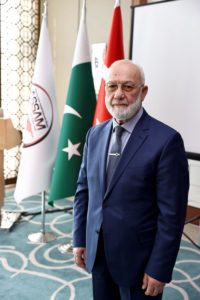
Adnan Tanrıverdi, a former chief military aide to Turkish President Recep Tayyip Erdogan and a staunch opponent of Israel who has advocated for an “Islamic NATO” alliance, played a key role in a purge of the Turkish army, helping replace experienced officers with loyalists and Islamist partisans.
The possibility of military confrontation with Israel is not without precedent. During the 2010 Mavi Marmara crisis, Erdogan pushed for a show of force, including the deployment of naval assets and fighter jets. Senior military commanders, however, strongly opposed the move, warning of the risk of escalation, legal complications and the potential for significant casualties.
Military officers warned that any such move carried a serious risk of rapid escalation and casualties, potentially dragging Turkey into an unnecessary conflict, and highlighted the legal and operational dangers of a direct clash with Israel over the flotilla. Erdogan was unable to overcome resistance from the generals, who at the time were more independent of the executive branch and wielded greater institutional power.
A similar pattern emerged in the early years of the Syrian conflict, when top generals resisted Erdogan’s push for military intervention. That resistance collapsed after the 2016 purges, which removed most, if not all, of the military’s independent leadership.
In the aftermath more than two-thirds of generals and admirals were dismissed or imprisoned, and the armed forces were rapidly restructured along ideological lines. One of the first major decisions following the purge was the deployment of Turkish forces into northern Syria.
Today, the Turkish military is widely seen as dominated by loyalists, Islamists, neo-nationalists and pro-Iranian elements. With the institutional checks of the past largely eliminated, there appears to be little or no internal resistance remaining to challenge Erdogan’s strategic decisions.
If Erdogan chooses to pursue a military confrontation with Israel, there are few — if any — senior officers left in the Turkish armed forces capable of opposing such a move.
Source: https://nordicmonitor.com/2026/04/turkey-has-quietly-preparing-a-war-with-israel-primary-target/
.png)