EXPERT COMMENT
PUBLISHED 4 MARCH 2026 —4 MINUTE READ
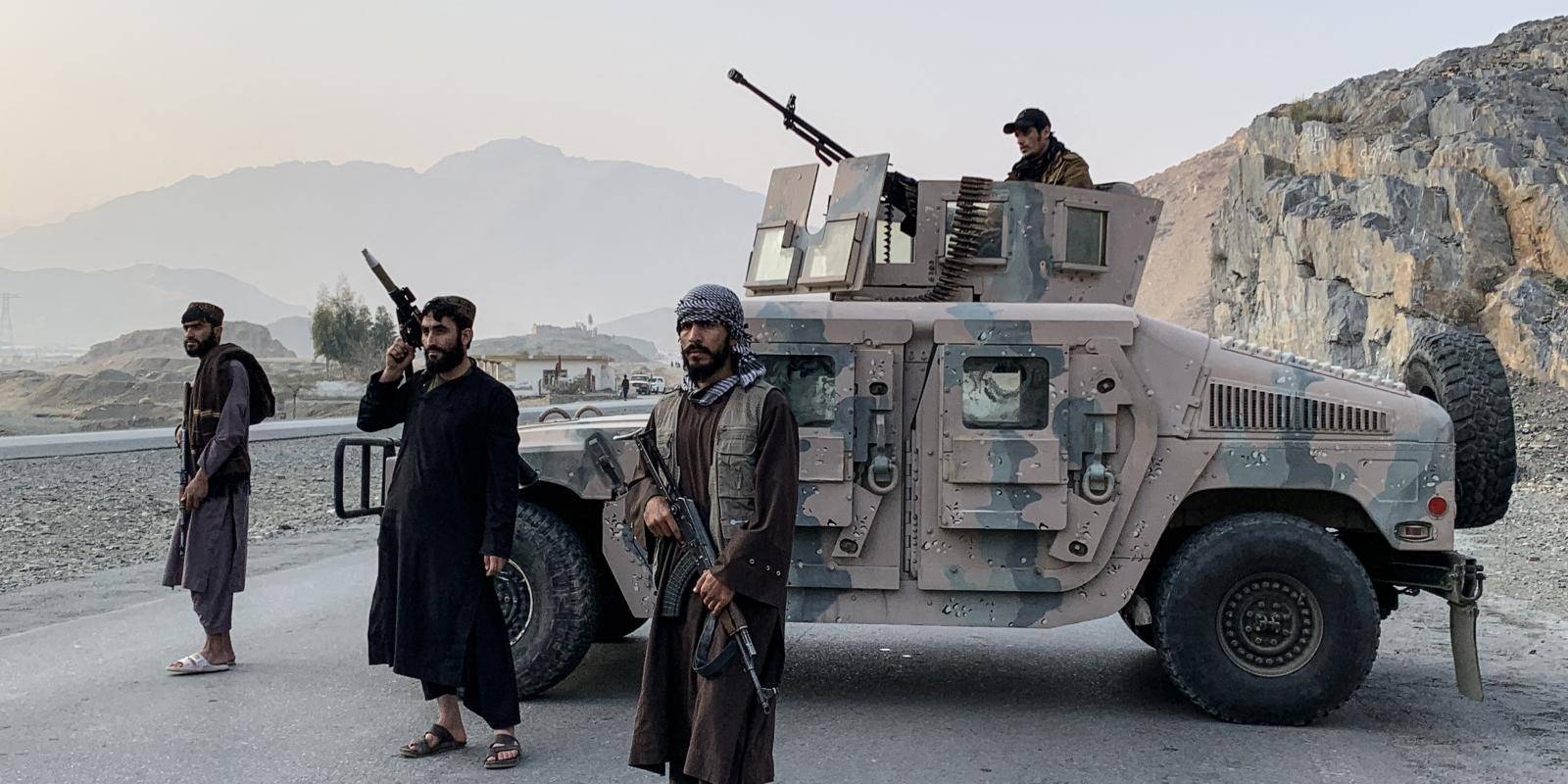
Image — Taliban security personnel stand guard near the Torkham border crossing between Afghanistan and Pakistan in the Nangarhar province on 27 February 2026. Photo by Aimal Zahir / AFP via Getty Images.
Fighting between Afghanistan and Pakistan has intensified in recent weeks, with no sign of de-escalation after Islamabad said it is waging an ‘open war’ against its neighbour.
Pakistan launched air strikes on Afghanistan last week in response to attacks on border posts by the Afghan military on 26 February. In a serious escalation, it targeted major cities including Kabul and Kandahar, as well as Bagram airbase. Kabul responded by targeting Pakistani military facilities.
These developments mark a clear escalation from the previous limited border skirmishes and use of proxies. Islamabad accuses Afghanistan of hosting separatist and terror groups that have carried out increasing attacks within Pakistan, including the Tereek-e-Taliban Pakistan (TTP, or Pakistan Taliban) and Baloch separatists. These groups contributed to a 34 per cent increase in the number of annual terror attacks inside Pakistan in 2025. The Taliban denies involvement.
Despite Pakistan’s superior military capabilities, the Taliban maintains a significant capacity for asymmetric warfare.
In November, the TTP carried out a suicide attack outside a district court in Islamabad, pointing to its growing reach beyond border tribal areas. The separatist Balochistan Liberation Army, which Pakistan says has sanctuaries in Afghanistan, also claimed attacks in Baluchistan province in January that killed almost 50 people.
The degree of direct complicity between Kabul and these militant groups is contested. At best, the uptick in attacks reflects Kabul’s inability to control militant activities within its borders; at worst, it reflects a degree of collusion between the Taliban and the TTP, who both espouse a similar conservative version of Sunni Islam.
These tensions are exacerbated by the forced repatriation of Afghan refugees from Pakistan. An estimated 2.7 million Afghans returned to Afghanistan in 2025 alone, mainly from Iran and Pakistan, contributing to a 12 per cent increase in population since 2023. The eviction of Afghan refugees from Pakistan is likely to accelerate amid the current tensions, placing further pressure on Afghanistan’s already stretched public services.
Afghanistan’s precarious economic situation has been further exacerbated by Islamabad’s decision to close the Afghan-Pakistan border in October and suspend all trade. As a landlocked country, Afghanistan is heavily dependent on Pakistan and other neighbouring countries for transit trade.
History of bad blood
The current conflict has deep historic roots. The Afghan government does not recognize the Durand Line, the 2,600km line demarcating the Pakistan-Afghanistan border that was drawn in 1893. The border goes through ethnic Pashtun areas and, as such, is opposed by Pashtun nationalists in Afghanistan. For this reason, Afghanistan was the only country to initially vote against Pakistan’s admission to the United Nations in 1947.
During the Afghan civil war in the 1990s, Pakistan supported the Taliban against the Northern Alliance, which was backed by India (as well as Iran and Russia). Islamabad has historically maintained close relations with the Taliban and initially welcomed the US/NATO withdrawal from Afghanistan and the Taliban’s return to power in 2021. But relations have since soured amid the recurring border skirmishes and attacks in Pakistan.
Afghanistan’s role in relation to the India-Pakistan rivalry has also strained relations. Historically, the Taliban was seen by New Delhi as a Pakistani proxy. This fuelled claims that Afghanistan was giving Pakistan ‘strategic depth’ in its rivalry with India, with Islamabad accused of seeking to leverage relations with the Taliban and other extremist groups to mount asymmetric attacks on India. New Delhi supported the 2001 US-led invasion of Afghanistan to oust the Taliban.
This has now reversed, with Pakistan accusing the Taliban of turning Afghanistan into a ‘colony of India’. This narrative has gained further momentum due to renewed hostilities between India and Pakistan following their brief four-day conflict last year, as well as Kabul and New Delhi moving towards a partial normalization of relations. Although India has yet to formally recognize the Taliban government, it has reopened its embassy in Kabul.
New Delhi may welcome conflict between Afghanistan and Pakistan as it diverts Islamabad’s attention away from its eastern border with India. But if the Pakistani military and intelligence establishment perceive an Indian hand behind Kabul’s actions, it could also fuel hostilities between New Delhi and Islamabad.
India conducts trade with Afghanistan via Iran’s Chahbahar port, where New Delhi is a key stakeholder. However, reported US and Israeli air strikes on the port city and the wider instability in Iran may now limit access via this route.
Impact on Pakistan
Pakistan’s unstable periphery also raises questions about the credibility of Islamabad’s broader regional ambitions.
Islamabad has demonstrated a growing ambition to play a more prominent role in the geopolitics and security of the Middle East. Pakistan and Saudi Arabia announced a ‘Strategic Mutual Defence Agreement’ in September. Pakistan also joined the ‘Board of Peace’ in January, prompting speculation about Pakistani peacekeepers being deployed to Gaza.
Yet while Islamabad remains eager to ingratiate itself with the Trump administration, it will be reluctant to get dragged into the Iran conflict or overextend itself in the Middle East as it faces instability with its other neighbours.
At the domestic political level, Pakistan’s recurring tensions with its neighbours have been used by the military to justify it maintaining a monopoly over the country’s foreign and security policies. The military and intelligence establishment will use the conflict with Afghanistan as grounds for further tightening its grip.
This comes amid recent concerns about the health of jailed former prime minister Imran Khan, who became increasingly critical of the military’s role during his tenure. Khan’s party, the PTI, currently controls the government of KP province, which borders Afghanistan. This will further complicate any diplomatic initiative between Afghanistan and Pakistan, given the difficult relationship between the KP provincial government and the national government in Islamabad.
De-escalation pathways
Countries in the Middle East have played an increasingly prominent role in trying to mediate Afghanistan-Pakistan hostilities in recent years. After their previous round of fighting, both sides agreed to a ceasefire brokered by Doha and Istanbul in October. This has been followed by Saudi-led mediation efforts. However, with renewed instability in the Middle East, Gulf states will have limited bandwidth to play a hands-on role in de-escalating Afghan-Pakistan tensions.
China is another possible contender, having held a trilateral foreign minister-level meeting with Afghanistan and Pakistan in August. Beijing has so far demonstrated a limited appetite for entanglement in inter-state tensions that do not directly threaten its national security. However, threats to its nationals and investments in Pakistan as part of the China-Pakistan Economic Corridor may prompt it to play a more hands-on role.
The US has also demonstrated a limited appetite to intervene. Even before Washington became preoccupied with its military operation against Iran, President Donald Trump had already stated that he did not see the need for the US to intervene or mediate as ‘Pakistan is doing terrifically well’.
In this context, the most likely de-escalation pathway runs directly through Islamabad and Kabul. Afghanistan lacks the airpower for a sustained conventional war. Pakistan has a limited appetite for a prolonged conflict amid ongoing tensions with India and the destabilization of Iran.
However, so far Islamabad has pledged ‘no compromise’ and demonstrated a limited interest in de-escalation. This creates a risk of Islamabad underestimating Kabul’s ability to inflict damage. Despite Pakistan’s superior military capabilities, the Taliban maintains a significant capacity for asymmetric warfare.
De-escalation could entail Islamabad reopening the border and resuming trade, in exchange for Kabul pledging to clamp down on militant sanctuaries on its soil. A spillover of instability from neighbouring Iran, for example through a surge in refugees, may also put pressure on Islamabad and Kabul to halt the fighting.
Source: https://www.chathamhouse.org/2026/03/afghanistan-and-pakistan-are-facing-open-war-de-escalation-needed
.png)